Friday, April 30, 2010

Did You Know?

For those who wonder, "Why should we change the way we educate our students? Isn't what we're doing now working well enough?"


I first shared this awesome video on artistew, where I serve as an arts-in-education contributor. I write under the penname Imagination, Unstifled. I'm usually published every week or so, so check it out! :)

Thursday, April 29, 2010

Government Works Better When DIALOGUE is Involved

Dear David Patterson,

Today, I have a big thumbs up AND a big thumbs down for you. We'll do the negative first, so we can end on a positive note. Sooo.... a 40% cut to the New York State Council on the Arts' local funding (grants)? REALLY? Per capita, that reduces the arts spending from $2.48 to $0.77. This drops us below the national average of $0.90 per capita arts spending. THIS IS NEW YORK! When you think of art, what state comes to mind first? WE DO. And if these cuts go through, we'll be spending less than average on arts for our citizens. In addition to the inevitable closure of several small cultural institutions across the state who DEPEND on that money, and the loss of arts opportunities for schools and communities, when it comes down to it, cutting that funding is also cutting JOBS. Tell Governor Patterson, Lt. Governor Ravitch and your Upper and Lower Chamber Representatives that you're NOT OK with this drastic cut by clicking here (I've posted similar advocacy links before- it takes TWO minutes to have your voice heard)!


And now, for the positive. Your new Straight Talk, Straight Answers Blog is a pretty darn good idea, Governor. Really- why didn't this exist before? This tool allows New Yorker tax payers to voice their concerns and discontents with the way their tax dollars are spent, ask questions and receive answers from the Governor's office, and brainstorm solutions to our crippling deficit. If you care about NY and how Albany spends your tax dollars, I would HIGHLY recommend checking out this site.

Wednesday, April 28, 2010

Arts credited for academic strides in Jefferson Parish Schools

Arts credited for academic strides in Jefferson Parish schools

By Jenny Hurwitz, The Times-Picayune

April 26, 2010, 8:00PM
arts-west-bank-teacher.JPGArtist educator Kendra M. Harris reviews a lesson linking the history of the Moors with modern-day history and the influence on current music and dance during the Cultural Crossroads Arts Program at Westbank Community School in Marrero. The program, which brings artist educators to work with at-risk students, was founded by and is administered through the Jefferson Parish Arts Society .

Standing before a small group of middle school students at Westbank Community School in Marrero, Kendra Harris demonstrated the first steps of an African courtship dance, shifting her bare feet back and forth across the floor.

"Your hip is leading you, but your body is pushing you over there," said Harris, who wore a traditional Senegalese dress and a blue gele, or scarf, wrapped around her head. "It's kind of flirty, right?"

Her students cautiously followed her movements, gradually picking up speed as they became less self-conscious. Harris told them that this dance was known as the Yankadi and had originated in Mali as a courting ritual that brought men and women together, back in the day when "there weren't clubs like there are now."

"They danced together under the moonlight," she said.

Harris, a transdisciplinarian and art educator, has come to the school as part of the Jefferson Performing Arts Society's Cultural Crossroadsprogram, which uses art to connect with students and help them improve in subjects like reading, writing, math and science.
arts=west-bank-drum.JPGSeventh-grader David Laieke plays the djembe drum in class during the Cultural Crossroads Art Program at Westbank Community School in Marrero.
At Westbank Community, an alternative school for middle school students who have been expelled, officials believe that an expansion of the program this year is partly responsible for a recent bump in reading scores, measured throughout the year as part of the district's interval testing, according to Karel Sloane-Boekbinder, director of the program. Officials also found a marked improvement in behavior among those students who participated in the program.

According to data supplied by the district, seventh- and eighth-graders saw moderate to significant gains in their reading scores earlier this year, a jump that coincided with an extended, two-month arts program.

The extended artist-in-residency program, which cost $5,000, was funded through Capital One Bank, Sloane-Boekbinder said.

While the arts program has been supplementing the school's curriculum for nearly a decade, Sloane-Boekbinder said the Capital One grant made it possible to lengthen the stints of each artist's residency beyond the typical length of one or two weeks.

"If we can keep the artists longer, the impact is greater," she said.
arts-west-bank-map.JPGArtist-educator Kendra M. Harris reviews a map of Africa with students.
Sloane-Boekbinder said the district is also looking to expand the arts program next year beyond the parish's alternative schools to include Paul Solis Elementary in Gretna, McDonogh 26 Elementary in Gretna and Norbert Rillieux Elementary in Waggaman. The schools were selected, in part, because of their slipping test scores and at-risk student population, although Sloane-Boekbinder stressed that she is hesitant to use the label "at-risk."

"If they can be shown a different approach, they're poised for achievement," she said. "If we can connect and inspire them by using art, they're going to catapult."

Back in their African dance class, students waved their arms, swayed their hips and rapped on African drums. But they also learned elements of African history, including the significance of the Berlin Conference; the influence of the Moors of Northern Africa; and where Mali and Morocco are located on the map.

Part-way through the lesson, seventh-grader David Laieke asked if he'd be allowed to come back to African dance class next week. He said he loves it because it gives him a chance to practice his drumming.

"I used to do African dance when I was little, so it inspires me to do that," he said. "It's fun. And it keeps me out of trouble. When I'm occupied with something I don't get in trouble." 

Jenny Hurwitz can be reached at jhurwitz@timespicayune.com or 504.826.3784.

Tuesday, April 27, 2010


My good pal Inga recently passed on an awesome opportunity that I'd love to share with you! Cosmetic Dentistry & Associates (the company Inga's mom works) is doing something pretty amazing for both you and humanity. Dr. Auster is participating in a program called: "Smile for Life" and it will last until June 30, 2010. Basically, they are doing free $300 dollar teeth whitening treatments using their top of the line stuff and all they're asking in return is a $100 contribution, 100% of which is donated to charities (including People to People foodband in Rockland, several children's hospitals including St. Jude's and dentistry for impoverished kids internationally). As spokespersons for the Children's Miracle Network, I urge you to take part in this program.

Click today on the “Make An Appointment” button on right of their website! Or, if you have additional questions, call the office at 845-364-0400. Ask for Dr. Peter Auster.

We'll Bring the Art To You

Browsing the NY Times this AM, I came across this article by Tamar Lewin, about museums and cultural organizations bringing their programming to schools when the cost to bus students, pay for lunch and admission and extra staff to take them off campus deters schools from visiting the museums themselves.


Museums Take Their Lessons to the Schools


SUTTON, Mass. — Sitting in the dark, knees crossed, looking up at the stars projected on the planetarium dome, the fourth-grade class might have been on a field trip to the Museum of Science in Boston.
Gretchen Ertl for The New York Times
Brooke Annis, center, a fourth grader in Sutton, Mass., inside a traveling planetarium.
Gretchen Ertl for The New York Times
Nicholas Culross, a kindergartner at the Simonian Center for Early Learning, walked in a dinosaur’s footprints during a traveling lesson from Christina Moscat.
But instead, they were having what Katie Slivensky, an educator from the museum, calls a “backwards field trip” in a portable, inflatable planetarium set up for the morning in the old gym at Sutton High School — a 50-minute lesson on the stars, moon and planets, tied to state learning standards for physical science, earth and space.
Over the last few years, many schools have eliminated or cut back on museum trips, partly because of tight budgets that make it hard to pay for a bus and museum admission, and partly because of the growing emphasis on “seat time” to cover all the material on state tests.
To make up for the decline in visits, many museums are taking their lessons to the classroom, through traveling programs, videoconferencing or computer-based lessons that use their collections as a teaching tool.
“Even if they can’t come to the museum, we can bring the excitement of science to the school,” said Ms. Slivensky, one of seven traveling educators at the Boston museum.
At the Museum of Science, where school visits have dropped about 30 percent since 2007, demand for the 14 school travel programs — from the $280 “Animal Adaptations” to the $445 “Cryogenics’ — is booming.
Annette Sawyer, director of education and enrichment programs, said the museum would do almost 1,000 travel programs next year, 400 more than four years ago.
On a sunny spring morning, the Sutton schools, about an hour from Boston, have brought in both the planetarium program and, for the kindergarten, “Dig Into Dinosaurs.”
“It’s $275 a bus, and we’d need three buses for a grade level,” said Michael Breault, the principal. “We pay for field trips and special assemblies from a magazine fund-raiser at the beginning of the year, and this year, we didn’t sell as many magazines.”
And museum admission costs $7.50 a head.
Money is not the only issue. Mr. Breault’s school recently adopted standards-based report cards, rating children on dozens of standards like “recognizes properties of polygons.”
Given the pressures to meet those standards, teachers said, the travel program’s efficiency is appealing.
“With a trip, there’s all the planning, the buses, the permission slips,” said Erin Fitzgerald, a fourth-grade teacher. “It’s hard to be gone a whole day. We have a lot of things to get through to get them ready to go into fifth grade, and there’s never enough time.”
Ms. Sawyer said her museum is “agnostic by design” about the relative merits of bringing students to the museum or taking the museum to students.
“Of course there’s a question about whether the travel programs cannibalize museum attendance,” she said. “But I don’t think so.”
Still, travel programs cannot replicate the excitement of the Museum of Science, where students visiting the theater of electricity scream loudly when they hear the bangs and see the artificial lightning snaking through the air.
In New York, both the Museum of Modern Art and the American Museum of Natural History reported a dip in school visits, and a spokesman for the natural-history museum said it was concentrating more on teacher development, including printed and online materials that could be used in the classroom.
Even as they pour their energies into taking museum resources to the classroom, some museum educators worry about how the shift might affect long-term attendance.
“It’s such a conundrum to advocate as strongly as possible for the magic of the real thing, but also create greater access using the Web, hoping we aren’t dissuading people from feeling the urgency of coming to see the real thing,” said Dana Baldwin, education director at the Portland Museum of Art in Maine, where school visits dropped more than 40 percent from 2007 to last year.
While it is difficult for art museums to take their wares on the road, her museum has developed handbooks, online materials and posters for in-class lessons. But, she admits, something is lost in the process.
Gretchen Ertl for The New York Times
Kindergartners on a make-believe archaeological dig.
“The experience of looking at art or posters in the classroom is so far removed from looking at art on a field trip to a museum,” Ms. Baldwin said.
At the Charleston Museum in South Carolina, Stephanie Thomas, the education coordinator, said educators began taking their programs to schools when gas prices went up. The mummy stays put, but the traveling educators have plenty of portable artifacts.
“We do a class on ancient Egyptian life, with a boys’ outfit and a girls’ outfit to put on, pieces of papyrus, a copy of the Rosetta stone, and some things that have been de-accessioned or are not in great shape, or come from someone’s grandparents’ attic, but we don’t know the provenance,” Ms. Thomas said. “We have an Egyptian headrest that’s chipped, but the kids don’t care that it’s chipped.”
The emphasis on specific learning standards for each grade, and No Child Left Behindassessments, has brought a fundamental shift in thinking about museum education.
“It used to be a given, like mom and apple pie, to take classes to the museum for enrichment, or as a reward for good behavior, in the spring,” said Ted Lind, deputy director of education at the Newark Museum, which had 84,000 student visits last year, down from 101,000 in 2005. “Now that there’s so much more pressure on time in the classroom, and learning standards, it’s all about how it will help students learn the curriculum. ”
No wonder, then, that for many students, the experience of wandering around a museum, exploring at will, has given way to formal lessons. In the Sutton gym, Ms. Slivensky began with basics. Star-watchers, she said, need to know time and direction. So which way is north?
“It’s up,” volunteered a tiny voice.
But are places north of Massachusetts, like Vermont, straight up in the air, Ms. Slivensky asked?
While the fourth graders discussed the night sky, the kindergartners passed around fossils, as Christina Moscat, the museum educator, asked them to guess what they were.
“I think this was a knee,” said Damian Weber.
Ms. Moscat identified the fossils, to much giggling. “You guys were touching dinosaur poop,” she said. “Only it’s not poop anymore, it’s stone. We call it coprolite, and it tells us what the dinosaur ate.”
Of 19 children in the class, only 7 had visited the museum.
“In this program, they get more focus on what paleontologists actually do,” Ms. Moscat said. “But they miss the wow factor of actually seeing that huge Triceratops skeleton.”


Monday, April 26, 2010

"Success usually comes to those who are too busy to be looking for it," - Henry David Thoreau

Wow. It's been a crazy past few weeks, and it's about to get crazier! I'm in finals for school, finishing up projects (due at the end of this week), and then I have an independent study to take in the May Term, and then I'M DONE WITH SCHOOL! (Until I start applying to grad schools in the fall...) It's also been a busy few weeks at work- the kids I work with are preparing for their culminating events in June, lesson plans are being rearranged, choreography is being re-worked, and I've found that the attention span of children has an inverse relationship to the temperature outside (and the temperature has been rising, so their focus has been DROPPING- I can't blame them- I like being outside too)!


Things have also been wonderfully busy with my Miss Greater NYC schedule! Last weekend, I had the opportunity to partner with NY Care's Art Explorers in Chinatown's Columbus Park Pavilion. They run a FANTASTIC free kids' arts program for anyone who's interested in stopping by. Above is a photo of myself with some of the other volunteers and our artwork from the day (volunteers can make art, too)! There will be another free arts session this Saturday, 5/1, from 2:30-4p in the Pavilion on the corner of Baxter and Bayard in Chinatown if you're interested! We'll be making Mother's Day inspired crafts! 


ABOUT THE CENTER:
Located in the heart of Chinatown, the Columbus Park Pavilion serves as foundation to organize and strengthen the community.  This neighborhood center offers a wide-range of free activities to the public.  From outdoor events such as live Chinese music and movies-in-the-park to indoor programs such as Art Therapy, Mama & Me, and of course Art Explorers, the center appeals to children, teenagers and adults of all ages.

ABOUT THE PROGRAM:
In the Art Explorers program at Columbus Park, kids from around the city visit the center and work with the volunteers on various arts and crafts.  Each themed-session generally revolves around a season or holiday.  Standard art projects can range from basic crafts (painting, coloring, beading) to more creative activities (origami, masks, puppets) or to special sessions (Easter eggdying, Tie Dye t-shirts, etc.). 


Later that day, I had a meeting with my dear friend and Mind the Art Entertainment president, Christian DeGre, and we continued to hash out details for our upcoming Shakespeare program, which will meld performing arts with the NYS ELA standards to be implemented in public high schools in NYC. I. CAN'T. WAIT.


That same day, I had an interview with Joe Antol about my experiences with pageants and preparations for the Tough Mudder race on May 2nd. The Tough Mudder folks were very excited to have a Miss America hopeful competing in their endurance race, and have sent some press my way- it's been great to chip away at the pageant stigma while discussing how I stay healthy, and how I'm getting strong for the upcoming race (using kettlebells with my AMAZING fitness sponsor- Ellen Stein- below is a photo from one of our workouts)!


I intern and train with Community Word Project in their Teaching Artist Training Internship Program, and I was honored to volunteer at their 10th Annual Benefit this past Tuesday. The event was held at the National Arts Club  (if you've not ever been inside this building, then you're missing out. Think Addams family home meets the Louvre meets a catacomb meets five star restaurant). The National Arts Club was kind enough to donate their amazing space, so all the proceeds went directly to CWP's programming. The evening was magical- students from several sites (including mine- go PS 27!!!) came and performed pieces they'd created with Community Word Project, the performance area was decorated with murals created during residencies, and there was an impressive silent art auction. It was also great to catch up with some of my friends that I hadn't seen since our training sessions ended a few months ago!


Paperwork for Miss NY was due this past week (OY), and I'm overjoyed to say that I've satisfactorily completed everything except for turning in my transcript (so HURRY UP, SUNY ESC...). Friday evening, Claire, Cassie and I hopped in a van with our director, Rene, and his friend Casey, and we headed up to Albany for workshop! After a few early snags (trouble with car rental, difficulty on 17 in Jersey, a little off-roading in our minivan and both mine and Claire's phones dying) we made it to Albany! After a brief visit with my sister, Kieren and her roommate, Amy, we hit the hay, and were up early the next AM for a full day of workshop! It was great to see so many familiar faces, and to meet all the new contestants. Congratulations to the Miss NY board for a smooth and well organized day. 

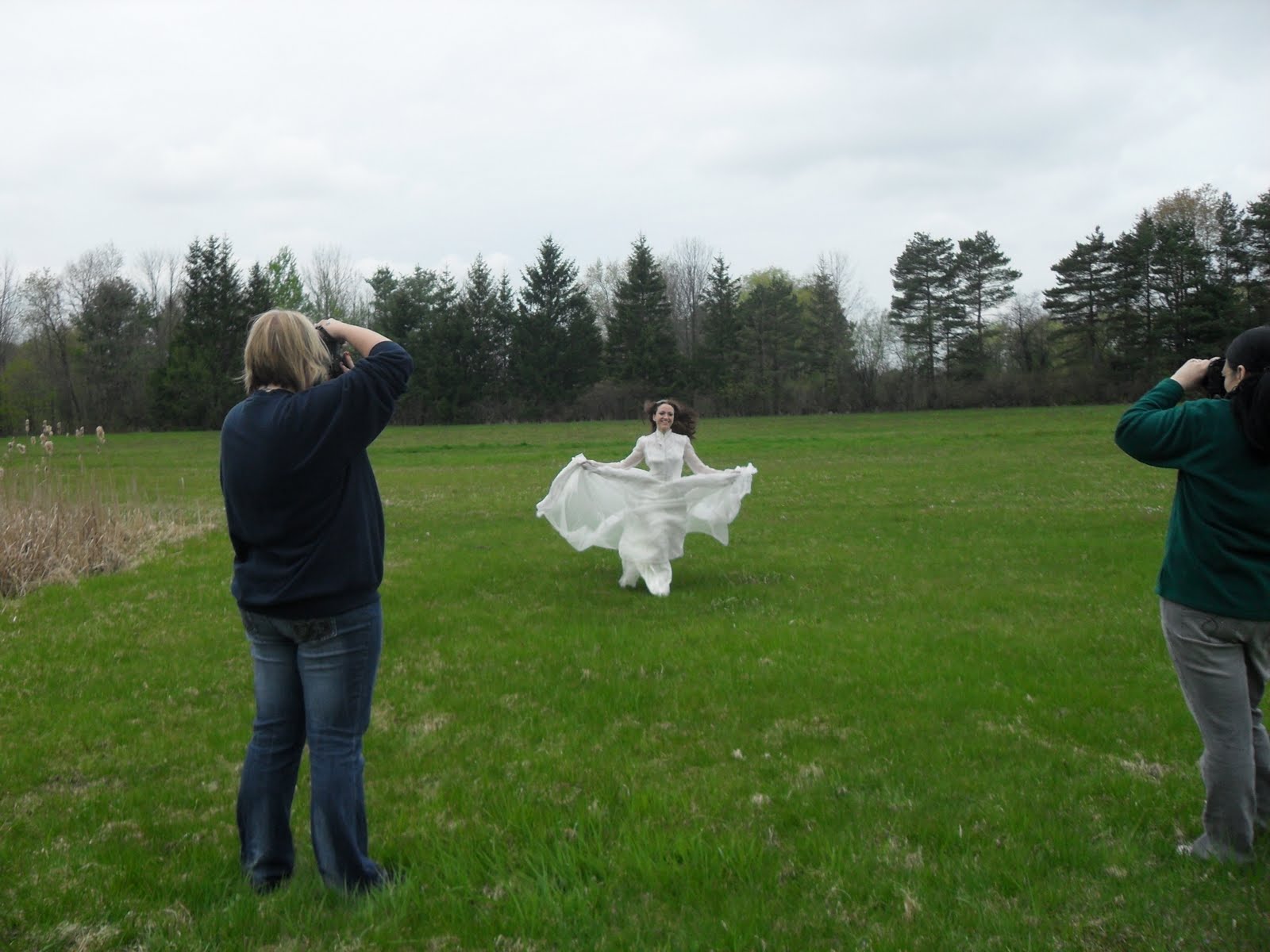
Before I headed back to NYC, I did a photoshoot with my friend Monica from MoDezinz and her friend Danielle from D Leguire Photography. My mom had given Monica some cool vintage clothing that we had no use for, and we spent the AM at my Aunt & Uncle's house in Amsterdam shooting outdoors! It was great to meet Danielle and see Monica again and to spend the AM with my mom (who took photos of the photographers photographing me), but it was also very special because I grew up playing in the field, pond and woods on my Aunt & Uncle's property, and it was such a trip down memory lane! I even dragged everyone into the woods to find "Mermaid Rock" (my sisters know what I'm talking about)- it was still there!
The lone forsythia bush near the pond.... AMAZING color!

An awesome 1950's wedding gown someone had given my mom years ago...


Oh, Hey, 80's prom dress...

A lot of exciting things are coming up this week! Thursday is the Emerging Leaders in Arts Education Meeting. Saturday I'm appearing at the Brooklyn Botanical Garden's Cherry Blossom Festival Grand Opening, and then Sunday I run the TOUGH MUDDER! AHHHHHHH!!! I'll keep you posted! 

Thursday, April 22, 2010

MR. EMPIRE STATE


NYC PAGEANTS in association with the 
MISS NEW YORK ORGANIZATION

‘THE 2010 MR. EMPIRE STATE PAGEANT’ TO BE HELD AT THE SPOON THEATER
SUNDAY, JUNE 13 AT 8 P.M. 

“The 2010 Mr. Empire State Pageant” Will Be Held at the Spoon Theater
NEW YORK, N.Y., - April 1, 2010 – NYC Pageants in association with the Miss New York Organization announced today that the “2010 Mr. Empire State Pageant” will be held on Sunday, June13th (8 P.M.) at the Spoon Theater (38 West 38th Street) in Midtown Manhattan.

 General Admission tickets are $18, which can be purchased in advanced by calling 212-579-0528 or visiting www.iseats.net (plus a $1.25 service charge.) Tickets, if available, may also be purchased at the box office, which opens one hour prior to performance. Cash only. A percentage of the proceeds from the pageant will be donated to the Children’s Miracle Network and to the NYC Contestant Preparation Fund.

Fifteen handsome young men from all over New York will compete for the prestigious title and help raised money for the Children’s Miracle Network In true Beauty Pageant style, these handsome young men square off in talent, eveningwear, on stage question and the ever-popular lifestyle and fitness in a swimsuit competition. The winner will receive over $1000.00 in cash and prizes.

A private VIP cocktail reception will be held one hour prior to the pageant. We invite you to mix and mingle with the contestants. A limited number of VIP tickets can be purchased for $30.00 (plus $1.25 service charge). To purchase VIP tickets please call 212-579-0528 or visit www.iseats.net. Reservations strongly suggestions.

Children’s Miracle Network is a non-profit organization that raises funds for more than 170 children’s hospitals. Countless individuals, organizations and media partners unite with Children’s Miracle Network hospitals to help sick and injured kids in local communities. Donations to Children’s Miracle Network create miracles by funding medical care, research and education that saves and improves the lives of 17 million children each year.

The Miss America Organization is one of the nation's leading achievement programs and the world's largest provider of scholarship assistance for young women. Last year, the Miss America Organization and its state and local organizations made available more than $45 million in cash and scholarship assistance. This assistance is not just for the handful of young women who become Miss America, but is available to the over 12,000 young women who compete in the state and local competitions as well.

Rich in history and social significance, the Miss America Organization is a not-for-profit organization that has maintained a tradition for many decades of empowering young women to achieve their personal and professional goals, while providing a forum in which to express their opinions, talent and intelligence. Scholarships have been the cornerstone of the Miss America program since 1945 when Bess Myerson was the first Miss America to receive a scholarship from the Organization.

Participating in the Miss America system not only helps pay for college and prepare for a career--it also provides an opportunity to gain additional life experience, working on issues of importance to society, enhancing your personal and professional skills and developing your performance-related and other talents.

NYC Pageants is the proud producer of The Miss Southeast/Miss Liberty/Miss Greater NYC pageants a local preliminary to Miss New York. The Miss New York Pageant is a franchised Miss America state pageant. Our educational scholarships are awarded through our 501(c)3 non-profit foundation. The Miss America Organization is one of the nation's leading achievement programs and the world's largest provider of scholarship assistance for young women. Last year, the Miss America Organization and its state and local organizations made available more than $45 million in cash and scholarship assistance. At last year’s pageant The Miss New York Organization awarded more than $21,000 in scholarships to the young women of New York pursuing their dreams of higher education.